
Puppy Supply List
Essential Items for Welcoming Your New Companion
Preparing for a new puppy requires gathering essential supplies before arrival. Having these items ready ensures a smooth transition for both puppy and family. The following list covers necessities for feeding, containment, grooming, training, and daily care.
Your puppy will arrive with a foundational take-home kit, but these additional supplies are necessary for continued care and training in your home.
Essential First Day Supplies
▼These items should be purchased and ready before your puppy arrives home. Having these essentials prepared ensures your puppy's first days are comfortable and safe.
Food and Water Bowls: Stainless steel bowls are recommended for ease of cleaning and durability. Regular cleaning prevents bacterial buildup that can cause illness. Clean bowls daily with dish soap, paying particular attention to water bowls where biofilm can develop.
Collar: Start with a flat buckle collar for everyday wear. The collar should fit snugly enough that it will not slip over the puppy's head but loose enough to fit two fingers between the collar and neck.
Identification Tag: Attach a tag with your phone number to the collar immediately. Even though your puppy will be microchipped, a visible ID tag allows anyone who finds a lost dog to contact you immediately without requiring a vet visit or shelter scan.
Dog Bed: Provide a comfortable place for your puppy to rest outside the crate. Puppies sleep 18-20 hours daily and need appropriate resting spaces.
Toys: Provide a variety of appropriate toys for play and enrichment. Chew toys are particularly important as puppies explore their environment through mouthing. Entirely edible chews that are soft enough to avoid breaking teeth are safest for young puppies.
Training Treats: Small, soft treats for training sessions and rewarding desired behaviors.
Poop Bags and Holder: Essential for responsible waste management during walks and outdoor time.
Walking and Training Equipment
▼Proper equipment for walking and training ensures safety and supports effective training from the beginning.
Walking Leash: A 4-6 foot leash provides appropriate control for regular walks and training sessions. This length allows the puppy some freedom to explore while maintaining handler control.
Long Line: A 15-foot long line is essential for recall training. Long lines allow puppies to practice coming when called at increasing distances while remaining safely tethered. Do not allow puppies off leash in unsecured areas regardless of training progress. Even well-trained dogs can be distracted or startled, and puppies lack the impulse control to reliably return in all situations.
Training Treats: High-value, small, soft treats work best for training sessions. Treats should be small enough to be consumed quickly without interrupting training flow.
Grooming Basics for All Owners
▼All standard poodle owners need basic grooming supplies for home maintenance between professional grooming appointments. These supplies support coat health, cleanliness, and early training for grooming acceptance.
Brushes and Combs: Three brush types are essential for poodle coat care. A fine-tooth comb (greyhound comb) works through the coat to detect and remove tangles. A pin brush maintains the coat between thorough combings. A slicker brush helps manage the coat during coat change, which typically occurs between 9-18 months of age.
Quality matters significantly with slicker brushes. Inexpensive slicker brushes often have sharp wire tips that can scratch or irritate skin. Invest in a quality slicker brush with properly finished wire ends. Your puppy's coat may not require extensive brushing initially, but establishing comfort with brushing tools now prevents resistance when the adult coat develops and requires regular maintenance.
Nail Clippers or Grinder: Regular nail maintenance is necessary for all dogs. Puppies receive their first nail trim before going home, but maintaining appropriate nail length is the owner's ongoing responsibility. Introduce nail trimming gradually and positively to create lifelong acceptance of this necessary care.
Toothbrush and Toothpaste: Dental care is vital to canine health. Begin a tooth brushing routine immediately upon bringing your puppy home. Daily brushing prevents periodontal disease, which affects overall health beyond just teeth and gums. Use dog-specific toothpaste. Human toothpaste contains ingredients toxic to dogs!
Puppy Shampoo: Puppy-specific shampoo is formulated to be gentler on developing skin and coat. CHI Tearless Puppy Shampoo has produced excellent results with our puppies and is safe for the face and eyes.
Blow Dryer: Force dryers significantly aid in maintaining a poodle coat and allow for the clean, fluffy appearance seen after professional grooming. Introduce blow drying gradually in short intervals while puppies are young to establish acceptance before the coat requires regular drying. Flying Pig manufactures high-quality force dryers suitable for poodle owners with multiple dogs or those who perform most grooming at home.
For complete guidance on maintaining your poodle's coat between professional appointments, see our Poodle Grooming Guide .
For specific product recommendations and purchase links:
Crate and Containment
▼Proper containment equipment keeps puppies safe during unsupervised periods and supports housetraining efforts.
Crate: Purchase an adult-sized crate appropriate for a standard poodle. Typically 42 inches in length. The crate must allow an adult dog to stand fully upright, turn around completely, and lie down stretched out comfortably.
Choose a crate with a divider panel for puppies. Young puppies learning house manners are less likely to eliminate inside appropriately sized spaces. Use the divider to create a smaller area initially, moving it back as the puppy grows and needs more space. This sizing prevents the puppy from using one end of a too-large crate as a bathroom.
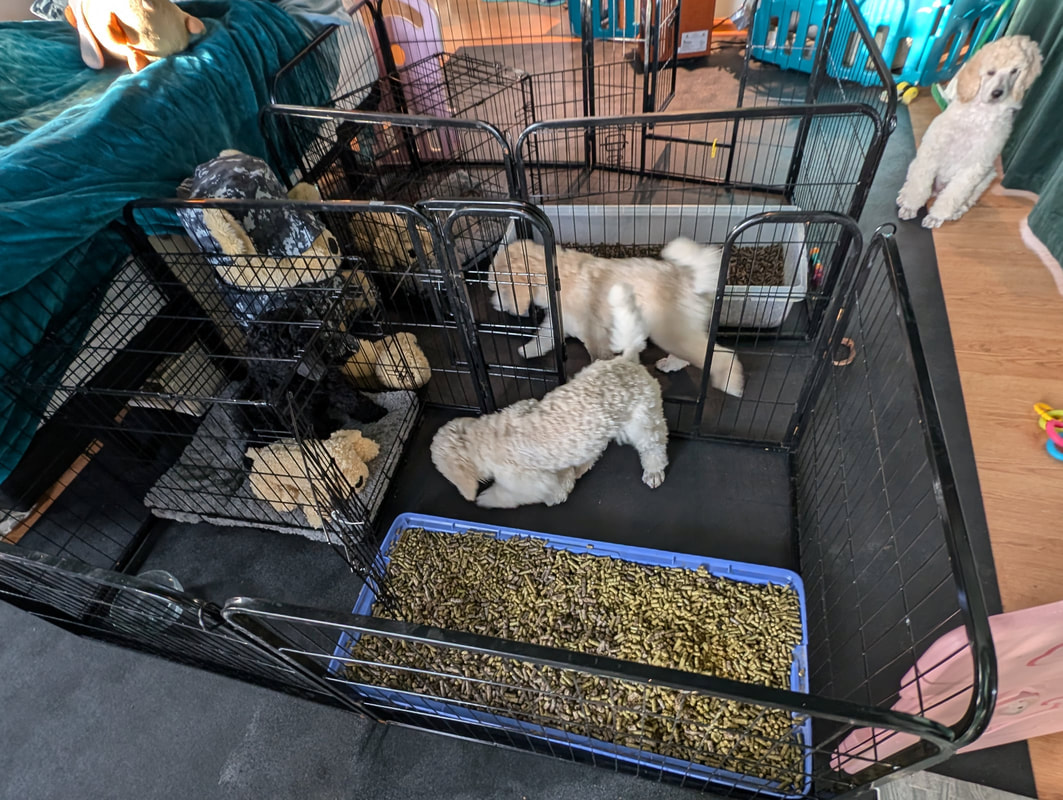
Exercise Pen and Litter Box Setup: For young puppies who require confinement during longer periods when direct supervision is not possible, connecting an exercise pen to the crate with a litter box creates an ideal solution. This setup provides three distinct zones: the crate becomes a safe resting space, the litter box offers an appropriate elimination area, and the remaining pen space allows for play and movement.
This configuration is particularly valuable during the early weeks when puppies cannot hold their bladder for extended periods. The setup supports natural cleanliness instincts by providing a designated bathroom area separate from sleeping and play spaces. As the puppy matures and develops better bladder control, the exercise pen can be removed and the puppy transitions to standard crate training.
Place the crate in a family area where the puppy can see and hear household activity rather than in isolation. Crates should be comfortable, safe spaces associated with rest and security, not punishment or loneliness.
Understanding Puppy Bladder Control
▼Young puppies have very limited bladder capacity and cannot hold elimination for extended periods. As a general guideline, puppies can hold their bladder one hour per month of age. A ten-week-old puppy (approximately 2.5 months) can only reasonably hold elimination for about 2.5 hours maximum, but often it will be less. By twelve weeks (3 months), expect 3 hours. At fifteen weeks (approximately 3.75 months), most puppies can hold elimination for about 3.75 hours during the day. These are maximum durations. Most puppies need more frequent opportunities, especially after meals, play, and naps.
Understanding these limitations helps owners set realistic expectations for housetraining progress. Accidents during the early weeks are not failures—they are normal developmental stages. Punishment for accidents is counterproductive and damages the trust relationship between puppy and owner. Instead, focus on providing frequent opportunities for success and rewarding proper elimination in appropriate locations.
As puppies mature, bladder capacity increases naturally. Most puppies achieve reliable daytime bladder control by 4-6 months of age, though nighttime control may take slightly longer. Individual variation exists. Some puppies progress faster while others need more time. Patience and consistency support successful housetraining regardless of the puppy's individual timeline.
Health and Safety
▼Support cleanliness, safety, and basic health management at home.
Enzyme Cleaner: Enzyme-based cleaning products effectively remove pet accidents and eliminate odors that might encourage repeat elimination in the same location. Only Natural Pet and Nature's Miracle are preferred brands. Standard household cleaners do not fully eliminate the biological components of pet waste, leaving scent markers that dogs can detect even when humans cannot.
Keep enzyme cleaner readily accessible during the housetraining period. Immediate, thorough cleaning of accidents prevents lingering odors that undermine housetraining progress.
Optional: Professional Grooming Equipment
▼Families who plan to perform their own grooming rather than using professional groomers need additional specialized equipment. Most families will use professional grooming services every 4-6 weeks and do not need these items.
If you plan to groom your own dog, consider purchasing:
Clippers: Professional-grade dog clippers designed for heavy coat types. Human hair clippers are not suitable for poodle coats.
Shears: Professional grooming shears for shaping and finishing work.
Grooming Table: A dedicated grooming surface at appropriate height makes grooming safer and more comfortable for both dog and groomer. Grooming on the floor or at inappropriate heights leads to poor body mechanics and incomplete grooming.
Bands: Small rubber bands for securing topknots or ear hair.
Professional grooming requires significant skill development, quality equipment investment, and time commitment. Many families find that professional grooming services provide better results with less stress for both dog and owner.
Learn more about finding a qualified groomer and what to expect from professional grooming in our Grooming Guide .
Additional Puppy Resources
▼Preparing for your puppy involves more than gathering supplies. For guidance on training, socialization, and early puppy care, explore our comprehensive resource library designed to help new puppy owners succeed.